Commercial cabbage farming offers fantastic profit margins, but field pests can steal your yields overnight. Managing the Diamondback Moth (Plutella xylostella) in cabbage crops is a constant battle for brassica growers, as this destructive pest can easily ruin an entire harvest if left unchecked.
To secure marketable cabbage heads, early detection, strict farm sanitation, and targeted chemical control using dual-action insecticides like Benocarb 100SC from Kenagro East Africa are essential.
What is the Diamondback Moth (Plutella xylostella)?
The Diamondback Moth (DBM) is a major pest that attacks cabbage, kale (sukuma wiki), broccoli, and other crops in the brassica family.
- Appearance: Adult moths are small and greyish-brown. When their wings are folded at rest, a pattern of diamond-shaped marks is visible along their back.
- Reproduction: DBM reproduces rapidly and completes multiple generations in a single growing season, making pest pressure build up quickly.
Understanding the 4 Life Stages of Diamondback Moth
Effective diamondback moth control requires understanding how the pest develops across its four distinct lifecycle stages:
1. Egg Stage
Female moths lay tiny, yellowish eggs individually or in small clusters on the underside of cabbage leaves. Eggs hatch within 3 to 6 days depending on weather temperatures.
2. Larval Stage (Caterpillar)
The larval stage is the most destructive phase of the pest:
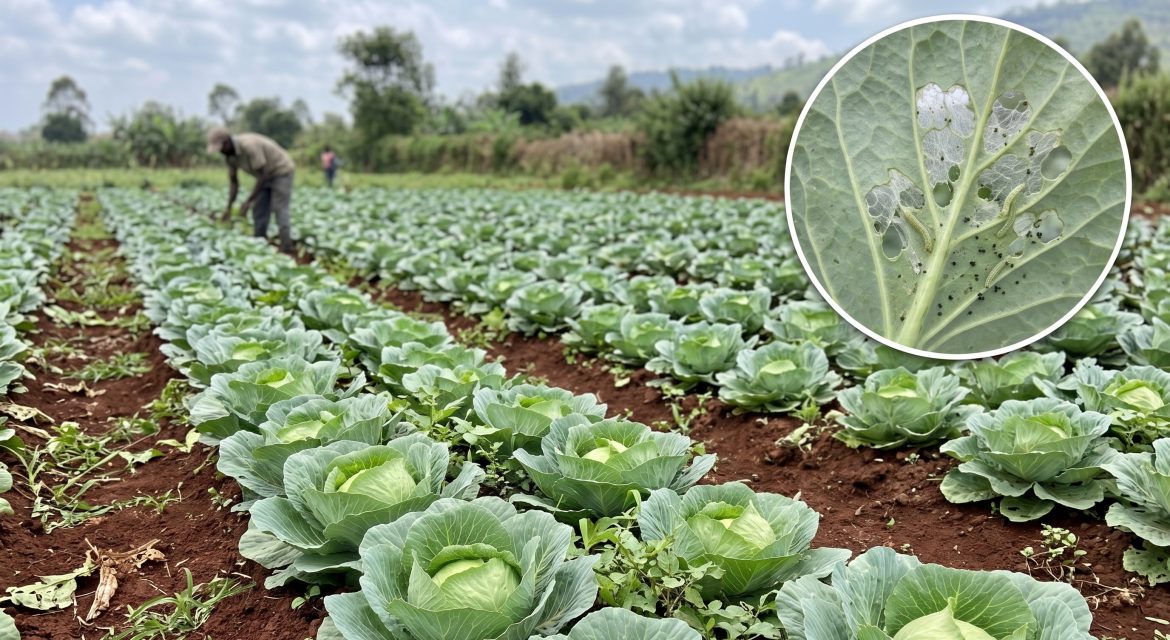
- Early Larvae: Newly hatched caterpillars wriggle actively and scrape the lower surface of cabbage leaves, leaving thin, transparent outer membranes known as “windowpane” damage.
- Late Larvae: Older caterpillars chew completely through the leaves, creating irregular holes and contaminating young forming heads with dark fecal pellets.
3. Pupal Stage
Mature caterpillars spin delicate, mesh-like silk cocoons on the undersides of leaves or lower stalks, inside which they transform into adult moths over 5 to 10 days.
4. Adult Stage
Adult moths emerge from cocoons to mate and lay eggs. Although adult moths do not feed on crop foliage directly, their high mobility allows them to spread infestations across neighboring fields rapidly.
Key Signs of Diamondback Moth Damage in Cabbage
Inspect your field regularly for these common damage indicators:
- Transparent “window-like” patches on young leaves.
- Small to large irregular holes across the leaf canopy.
- Caterpillars dangling from silk threads when leaves are disturbed.
- Poor, delayed, or completely stunted cabbage head formation.
- Presence of caterpillar frass (excrement) trapped inside head layers.
Agronomic Practices for Integrated Pest Management (IPM)
Relying on insecticides alone can lead to pest resistance. Combine chemical sprays with proven cultural practices:
- Regular Field Scouting: Inspect cabbage vines at least twice weekly, examining leaf undersides for eggs and early larvae.
- Crop Rotation: Avoid planting cabbage, kale, or broccoli continuously on the same plot. Rotate with non-brassica crops like beans, maize, or onions to disrupt the pest lifecycle.
- Field Hygiene: Promptly uproot and destroy crop residues after harvest to prevent lingering pupae from infesting new plantings.
- Weed Control: Remove wild mustard, turnip weed, and other brassica weeds around field borders that host DBM populations.
- Proper Spacing: Maintain ideal plant spacing to promote airflow and ensure spray coverage reaches inner leaves.
Chemical Control: Dual Active Ingredients
When caterpillar populations cross economic thresholds, active chemical intervention is necessary. Combining active ingredients with complementary modes of action ensures fast knockdown and long residue:
- Indoxacarb: A powerful nerve-entry blocker that stops caterpillar feeding within hours of ingestion and causes rapid paralysis.
- Emamectin Benzoate: A high-potency translaminar insecticide that penetrates leaf tissue to eliminate deep-feeding caterpillars.
Recommended Solution: Benocarb 100SC
For reliable, dual-action control of diamondback moth caterpillars, Benocarb 100SC (from Kenagro East Africa) delivers superior field protection:
- Active Ingredients: Indoxacarb 85g/L + Emamectin Benzoate 15g/L
- Formulation: Suspension Concentrate (SC)
- Key Benefits: Fast feeding cessation, translaminar leaf penetration, long residual control, and resistance management.
Pro Tip for Farmers: Spray Benocarb 100SC early when larvae are small. Ensure water volume is sufficient to thoroughly wet the undersides of leaves where caterpillars shelter.
Frequently Asked Questions (FAQs)
Q1: What causes transparent windowpane spots on cabbage leaves?
Early-stage diamondback moth larvae feed by gnawing away the lower leaf tissue while leaving the upper wax membrane intact, creating clear “windowpane” patches.
Q2: Why is diamondback moth so difficult to control?
DBM reproduces rapidly and quickly develops resistance to single-active insecticides. Using dual-active products like Benocarb 100SC breaks resistance pathways.
Q3: When is the best time to spray cabbage for caterpillars?
Begin spraying proactively at early crop setup or at the first sign of leaf windowing, targeting the undersides of leaves before caterpillars penetrate deep into forming heads.