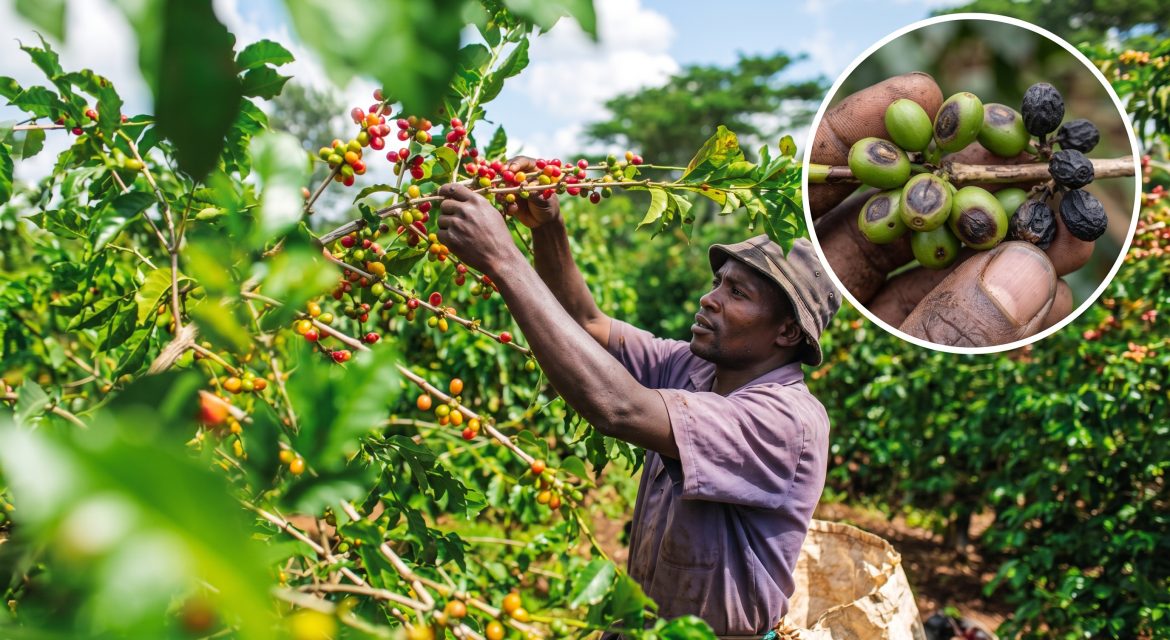
Coffee is a high-value commercial crop supporting thousands of farming households, but fungal infections can devastate yields and bean quality if not managed early. Among all fungal threats affecting Arabica coffee, Coffee Berry Disease (CBD) is the most destructive.
When CBD strikes during cold, wet, high-altitude rainy seasons, farmers can lose between 50% to 80% of their total harvest. This guide breaks down how Coffee Berry Disease develops, essential cultural control practices, and how to effectively apply Bugati 500SC for complete crop protection.
Quick Reference: CBD Identification & Spray Matrix
| Disease Stage | Key Visual Symptoms | Favorable Conditions | Bugati 500SC Dosage Rate |
| Early Infection | Small, dark brown or black slightly sunken spots on young green berries. | High humidity, rain, cold weather (15–20°C) | 15–20 ml per 20L water |
| Active Infection | Enlarged, deeply sunken, soft rotting lesions on expanding berries. | Continuous rainy spells, dense unpruned tree canopy | 15–20 ml per 20L water |
| Advanced Stage | Total berry mummification (black, dry, hard); premature berry drop. | Prolonged wetness, untreated early infections | 15–20 ml per 20L water |
1. What is Coffee Berry Disease (CBD)?
Coffee Berry Disease is a virulent fungal infection caused by the pathogen Colletotrichum kahawae. It selectively targets green, expanding coffee berries during their susceptible development stages (between 4 to 20 weeks after flowering).
How CBD Develops in the Field
- Early Infection Stage: Dark brown or black circular spots appear on young green berries. At this point, the fungal spores are germinating on the berry surface.
- Active Disease Stage: Spots expand and sink into the pulp, causing soft rot. Rain droplets splash spores from infected clusters to neighboring healthy green berries.
- Advanced Mummification Stage: The entire berry turns black, dries up, and mummifies. Infected berries either fall to the ground or hang on branches as source pools for future infections.
2. The Economic Impact of Uncontrolled CBD
Failing to implement preventative and early curative spray programs leads to:
- Severe Crop Losses: Up to 80% loss of green berries during heavy rainy seasons.
- Poor Bean Quality: Diseased berries yield damaged, light, or discolored coffee beans.
- Reduced Farmer Income: Lower yield volumes and degraded quality grades mean lower market payouts.
- Tree Stress: Early berry drop disrupts plant energy reserves, weakening trees for subsequent seasons.
3. Agronomic Best Practices for CBD Management
Chemical management works best when integrated with sound cultural practices:
- Regular Tree Pruning: Open up the canopy by removing dead, interlocked, or excess branches. Increased airflow dries wet leaves and berries quickly, lowering fungal spore survival.
- Field Hygiene & Sanitation: Strip off and destroy all mummified berries left on trees or fallen on the ground after harvest to eliminate over-seasoning spores.
- Proper Tree Spacing: Maintain recommended field spacing to prevent canopy overcrowding and reduce micro-climate humidity.
- Balanced Nutrition: Apply recommended NPK and micronutrient fertilizers to boost natural tree immunity against fungal attacks.
4. Dual-Action Defense: Why Choose Bugati 500SC?
For strong preventative and curative control of Coffee Berry Disease, Bugati 500SC from Kenagro Suppliers Limited offers a powerful combination of two broad-spectrum active ingredients:
- Azoxystrobin (200g/L): A broad-spectrum strobilurin fungicide with protective action. It remains on the berry and leaf surface to inhibit spore germination and fungal energy production.
- Tebuconazole (300g/L): A systemic triazole fungicide with curative and eradicant action. It penetrates internal plant tissues to eliminate active fungal infections from within.
Together, these active ingredients stop existing infections and guard against new spore invasions.
5. Application Rates and Spray Instructions for Bugati 500SC
- Knapsack Dosage: Mix 15ml to 20ml of Bugati 500SC per 20-liter knapsack sprayer.
- Per-Hectare Rate: Apply 0.75L to 1.0L per hectare in sufficient water volume (approx. 1,000L/ha) for thorough canopy coverage.
- Spray Timing:
- First Spray: Apply preventatively at early berry development (4–8 weeks after main flowering) before heavy rains start.
- Follow-up Sprays: Repeat applications at intervals of 21–28 days during high-risk rainy periods.
- Pre-Harvest Interval (PHI): Observe a safety waiting period of 14 to 21 days between the last application and harvest.
Pro-Tip: Direct spray nozzles into the inner canopy clusters where green berries develop. Adding an agricultural spreader/sticker during heavy rainy seasons prevents rain wash-off and improves coverage.